إظهار الرسائل ذات التسميات information about koi fish. إظهار كافة الرسائل
السبت، 9 مايو 2015
الخميس، 7 مايو 2015
Pond Filtration
Keeping Pond Water Clean and Clear
Filtration is essential in order for a pond to have Koi in it. If there is no filtration on a pond with fish in it, they will eventually poison themselves from the toxins that they produce. The three main types of filtration are listed below. Biological, mechanical and chemical filtration will all keep your pond clean. The most common method of filtration used is the biological/mechanical filtration combination.
Types of Filtration
This type of filtration is the easiest to maintain. You may also want to read about the Nitrogen cycle, in order to learn the science behind biological filters.
This type of filtration is used to remove solid waste and large debris like fallen leaves from your pond.
These filters strip the toxins right out of the water altogether. This type of filtration ends up costing the most in the long run.
This type of filtration affects algae, small parasites, and bacteria. It uses an Ultraviolet light to kill anything that flows through it.
Construction
This has been used throughout the world for moving water for the last few decades.
Koi Fish Meaning Definition
Chinese Koi Fish Meaning
Koi fish are kept in ponds all over the world, but they have a special meaning in Asia. A couple thousand years ago, a legend in China was formed that told how carp (Koi) that swam up a waterfall and through the dragon gate were magically transformed into dragons. Through perseverance and endurance, the carp were able to become mythical beings. Two thousand years later and the Koi fish still symbolize perseverance and endurance. This was also the basis of the Pokemon Magicarp turning into Gyarados in the video game.
Japanese Koi Fish Meaning
In Japan, Koi are known for their masculine and positive qualities. They are the official symbol for the Children's Day (May 5th) festival in Japan. On Children's day, families hang a Koi windsocks (KoinoBori) for every member they have in their household. Another quality that the Japanese symbolize with is strength for overcoming life's difficulties. By persevering in life's endeavors, one can better him or herself.
Koi fish symbolize perseverance,
ambition and advancement
Koi Varieties
The names for each type of Koi have meaning. They are:
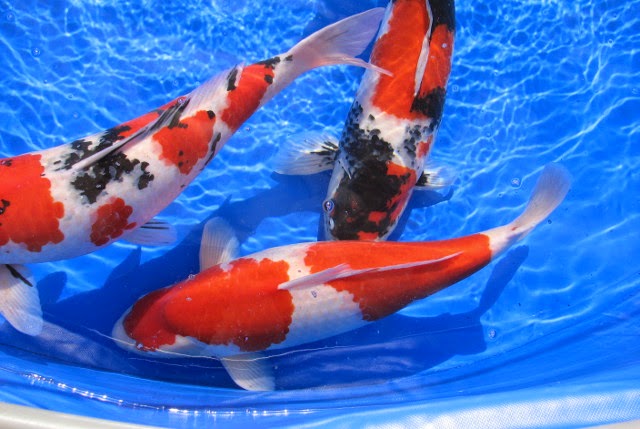
- Gosanke: The big three (Kohaku, Sanke and Showa)
- Kohaku: Amber (The red color of the pattern)
- Taisho Sanshoku (Sanke): Three colored Koi that was established during the Taishō era
- Showa Sanshoku (Showa): Three colored Koi that was established
in the Showa era - Bekko: Separate (The separate black spots of color)
- Utsuri: Reflection (The pattern on an Utsuri variety is like a
checkerboard) - Asagi: Light Blue (The color of the Koi)
- Shusui: Gather water from a lake or river
- Tancho: The Koi has a single spot of color on the head, like Grus Japonensis,
the Japanese Crane - Hikarimono: Bright, like a meteorite
- Ogon (correct spelling: ougon): Gold (Any single colored
metallic Koi has Ogon placed after the name) - Nezu: Dark Grey
- Yamabuki: Japanese yellow rose
- Koromo: Gown (the fancy shading of the scales)
- Kin (correct spelling: kinu): silk (metallic color that is shiny
like silk) - Kujaku: Peacock
- Goi (Koi): Carp
- Matsukawa Bakke (short for Bakemon): Pinecone River Ghost
- Doitsu: Germany (where the scaless carp were imported from)
- Kikusui: Light chrysanthemum
- Matsuba: Pine needle (pinecone shading of the scales)
- Ochiba Shigure: Fallen leaves from rain
- Kumonryu (Ku Mon Ryu): Nine Crest Dragon (A crest "monshō" is
the Japanese version of a coat of arms) - Kuchi: Lips
- Karasugoi: Raven Carp (black like a raven)
- Hajiro: A duck with bright patches on its wings (The Koi have
white on the tips of the fins) - Chagoi: Tea carp (brown colored like tea)
- Kigoi: Yellow carp
- Midorigoi: Green carp
Koi Colors
Oftentimes, varieties of Koi are broken down into color variations.
For instance, Utsuri Koi come in three color varieties: Hi Utsuri, Ki
Utsuri and Shiro Utsuri (red, yellow, and white). Here is the
meaning of the Koi fish colors:
For instance, Utsuri Koi come in three color varieties: Hi Utsuri, Ki
Utsuri and Shiro Utsuri (red, yellow, and white). Here is the
meaning of the Koi fish colors:
- Shiro: White
- Ki: Yellow
- Hi: Red
- Beni: deep red
- Sumi: Black
- Orenji: Orange
- Purachina: Platinum
- Budo (correct spelling: budou): Grape
- Midori: Green
Koi Herpes Virus (KHV)
Koi Herpes virus is extremely infectious. It takes as little as ten minutes of exposure to infect a Koi. Although, the virus can only live 24 hours without a host. Goldfish are not susceptible to Koi Herpes Virus. Even the Koi/Goldfish hybrids are usually immune too. Koi Herpes Virus (KHV), is also know as Carp Gill Necrosis Virus. There are two reasons for the different names:
- The virus affects all types of Cyprinus carpio, it is not limited to Koi
only. - Scientists are still not sure that this virus is a true Herpes Virus
(Herpes viruses can lay dormant for years before an outbreak is triggered,
usually by immunosuppressant conditions like stress). Koi Herpes Virus History
In the spring of 1998, large amounts of food carp and ornamental Koi started to die in farms in Israel. This mysterious virus spread all over Israel and then eventually into other parts of the world, due to unregulated trade. Carp Gill Necrosis Virus has cause tens of millions of dollars in damage ever since the first outbreak nearly ten years ago. In the fall of 2003, Lake Kasumigaura and Lake Kitaura in Japan experienced a KHV outbreak. $2.55 million dollars were lost in a week alone. The food carp industry in Japan is still trying to recover, for supply is still very low because those two lakes were the largest producers of carp.The symptoms of Koi Herpes Virus are:
- Fatigue
- Gill Necrosis
- Gasping at the Surface
- Increased Mucus Secretion
- Sunken Eyes
- Pale Patches of Skin
KHV Spread and Control
When there is an outbreak of Koi Herpes Virus, there is usually a 80%-90% mortality rate in a pond. It takes a Koi about 3 weeks to develop a sufficient amount of antibodies in order to fight off the virus. Unfortunately, Koi Herpes Virus is deadly enough to kill a Koi within a week of initial exposure. This can be combated by raising the water temperate above 86 degrees Fahrenheit for a month in order to suppress the virus long enough for enough antibodies to develop. Although, if KHV is a herpes virus, an "immunized" Koi will infect any other Koi with no prior exposure and then a massive die off will ensue.If you believe that you have had an outbreak of Koi Herpes Virus in your pond, contact a local veterinarian that is knowledgeable in Koi health. Several Koi may be needed for sacrifice in order to obtain good samples for PCR testing.KHV Prevention Information for Koi Keepers
The best way to prevent an outbreak of Koi Herpes Virus in a pond is QUARANTINE. Quarantine is the #1 proven method to stop the spread of disease. New Koi should be quarantined for a minimum of 3 weeks at 75 degrees Fahrenheit before they can be released into the general population.
Pseudomonas fluorescens
Pseudomonas fluorescens, also called ulcer disease or just Pseudomonas, is not as common as Aeromonas. It does not kill nearly as fast as a virus like KHV, but if not treated, a Koi will usually eventually succumb to the disease. Pseudomonas is an opportunistic bacteria. Koi will only get an infection if something else has harmed them in any way, especially if portions of their slime coat have been stripped away. Aeromonas and Pseudomonas usually exhibit the same symptoms. The skin ulcer will grow bigger and bigger until muscle tissue is exposed. After that, the infection turns septic and spreads throughout a Koi in their blood stream. The kidneys usually fail next and then a Koi's ability to osmoregulate fails. This causes the condition known as dropsy, or pine cone disease. The Koi will expire, usually within two weeks as more and more bodily functions fail.
Koi can get an Pseudomonas infection from:
- Stress
- Abrasive Pond or Tank Surfaces
- Rough Handling
- Parasites
- Bad Water Quality
- Other Immunosuppressant Conditions (i.e.. cold water, moved from tank to
pond, being constantly frightened by a person or animal, ect.)
If a Koi gets an Pseudomonas infection, remove it from the pond and put it into a heated hospital tank immediately. Warm water will boost a Koi's immune system and will quicken healing. There are a couple options for treatment. One, is Tricide-Neo. Tricide-Neo creates holes in the cell wall of Pseudomonas, allowing antibiotics to enter and destroy the disease. Antibiotic injections can also be used. If injections are the route you take, have a licensed veterinarian come out, take a tissue sample and then send it in for a susceptibility test. With the results, antibiotic treatment will be like a laser guided missile. There will be no guessing which antibiotic will work the best. The Koi can be put back into the general population when it has completely healed up.
Aeromonas hydrophilia
Aeromonas hydrophilia, also called ulcer disease or just Aeromonas, is the number one killer of Koi. It does not kill nearly as fast as a virus like KHV, but if not treated, a Koi will usually eventually succumb to the disease. Aeromonas is always present in water, it is also an opportunistic bacteria. Koi will only get an infection if something else has harmed them in any way, especially if portions of their slime coat have been stripped away. Aeromonas and Pseudomonas usually exhibit the same symptoms. The skin ulcer will grow bigger and bigger until muscle tissue is exposed. After that, the infection turns septic and spreads throughout a Koi in their blood stream. The kidneys usually fail next and then a Koi's ability to osmoregulate fails. This causes the condition known as dropsy, or pine cone disease. The Koi will expire, usually within two weeks as more and more bodily functions fail. Nowadays, many strains of Aeromonas are very resistant to antibiotics. This is due to the abuse of antibiotics by the Koi breeders over the years, so they could lower mortality rates, and then increase profit.
Koi can get an Aeromonas infection from:
- Stress
- Abrasive Pond or Tank Surfaces
- Rough Handling
- Parasites
- Bad Water Quality
- Other Immunosuppressant Conditions (i.e.. cold water, moved from tank to
pond, being constantly frightened by a person or animal, ect.)
If a Koi gets an Aeromonas infection, remove it from the pond and put it into a heated hospital tank immediately. Warm water will boost a Koi's immune system and will quicken healing. There are a couple options for treatment. One, is Tricide-Neo. Tricide-Neo creates holes in the cell wall of Aeromonas, allowing antibiotics to enter and destroy the drug-resistant strains of Aeromonas. Antibiotic injections can also be used. If injections are the route you take, have a licensed veterinarian come out, take a tissue sample and then send it in for a susceptibility test. With the results, antibiotic treatment will be like a laser guided missile. There will be no guessing which antibiotic will work the best. The Koi can be put back into the general population when it has completely healed up.
Argulus foliaceus (Fish Louse)
Argulus, also known as fish louse or fish lice, is a tiny parasite that posses a crustacean exoskeleton. It has two large circular suckers that it uses to attach to the skin of a Koi. Argulus has a spike that is uses to poke a hole and feed on blood. Argulus is an egg layer, it will lay several hundred eggs on solid surfaces like rock. The eggs have a gestation period of about a month. Argulus take about a month and a half to grow out enough to be able to see. During this time, they will attack any fish or amphibians in the pond. Argulus, like any other parasite, can cause a secondary infection like Aeromonas. Be careful when holding a larger Argulus, it will use its spike to defend itself.
What can I do for my sick Koi?
Use the following tips to speed up recovery time if your Koi has an ulcer or bacterial infection.
- Move the Koi to a hospital tank
Keeping Koi in a small tank during an illness will allow you to easily keep an eye on the fish during its treatment and recovery. It will also let you easily catch the sick fish to administer treatment. A hospital tank setup needs adequate filtration, aeration and regular water changes. You want to provide an optimum environment for the Koi to live in while it's healing. - Add salt to the water
Add one pound per 100 gallons of pure salt (no additives like Iodine) to boost their slime coat thickness and to help the sick Koi with its osmoregulatory system. The osmoregulatory system controls how much water a fish absorbs and expels from its body. If your Koi is in the pond, remove any plants. Salt kills freshwater plants. - Follow the veterinarian's treatment regimen
Only a vet can prescribe internal antibiotics to an animal. The vet will give you a treatment regimen to follow with the antibiotics. If there are no fish vets in your area, you can try a Tricide-neo medicated bath to treat an ulcer. - Keep the water warm
Keep the water at 75 degrees F. Warmer water speeds up their immune system and their healing time. - Don't move your Koi until it's healed up
Moving your Koi back to the pond before the ulcer has healed is a bad idea. The hospital tank will have a low bacteria count in the water, which is good for a healing Koi. A pond will have a higher bacteria count, since it is a larger body of water that is stocked with many fish. Moving your Koi back before it is healed up is a great way to have another infection happen to your fish.
الأربعاء، 6 مايو 2015
Ten Things You Didn’t Know About Koi Fish
1. They are illegal in the state of Maine
In 2014, a woman named Georgette Curran had her Koi forcibly removed from her residence after a failed attempt to legalize Koi keeping in her home state. Having a Koi pond and keeping Koi fish is currently legal in 49 out of 50 states. She fought all the way to the state supreme court, but was ultimately rejected when they upheld the lower court’s ruling.
2. Koi can be worth tens or even hundreds of thousands of dollars
Koi that have the perfect body conformation, skin quality, color, and pattern of color are sought after by hobbyists who want to compete in Koi shows. Competition is fierce and many will pay big money in order to gain an edge on other entrants.
3. Koi can grow up to 3 feet long
You may have only seen the small fish in the tanks at your local pet shop, but given the right conditions, Koi can grow from 2 to 6 inches a year. Before long they can grow larger than a cat or a small dog!
4. Koi can survive the winter outside in the pond
They are cold blooded and can adapt to conditions in large temperature range. During the winter, Koi go dormant and remain at the bottom of the pond where the water temperature is the warmest. A hole in the ice is required so that fresh oxygen can enter the water and carbon dioxide can exit.
5. Without a filter, they would poison themselves
Koi excrete Ammonia through their gills and in their fish waste. Without a filter to process the Ammonia, the concentration will build up in the water and their pond environment will eventually become toxic.
6. Koi come in over 200 varieties
Koi can be red, white, black, yellow, brown, grey, green, blue and have several combinations of those colors. The colors can also be non-metallic or metallic. There are even scaleless, longfin and gin rin, which is a pearlescent addition to the color for varieties of Koi.
7. They can be trained to eat from your hand
If you hold Koi food in your hand and then place it in the water while staying still, they come up and eat right from your hand. Though it may take a few days or even a few weeks for them to get used to you.
8. Koi will follow you around the pond and beg for food
They will even do it 20 minutes after you feed them. Sometimes they act like they are starving.
9. Carp were first introduced into the US in the mid 1800’s as a food source
The introduction of carp into US waterways was so successful that carp soon became a nuisance. It didn’t help that the American public isn’t too fond of the taste of carp either.
10. People keep Koi as pets on 6 out of 7 continents
Koi keeping is now a worldwide hobby. Until the 1960’s, Koi keeping was almost exclusively a Japanese practice. The advent of jet travel and polypropylene bags changed that and the hobby started spreading around the world.
الاشتراك في:
الرسائل (Atom)